AI adoption & change
Stop Losing What Your People Know: Building an AI Knowledge Repository in 2026
What walks out the door when your best person leaves?
It's not just a role you need to fill. It's years of know-how: the shortcuts, the client history, the "here's what actually works".
Panopto's Workplace Knowledge and Productivity Report (2018) put a number on this. It found that 42% of the knowledge in a role is unique to that person. If they leave, nobody else can do that 42% of the job.
Most organisations still treat this as bad luck. In our view at Breakfree, it's a design problem. An AI knowledge repository that keeps SOPs and process know-how current can fix it.
How much time do people lose looking for answers?
The same Panopto study found:
These numbers date from before generative AI. The problem hasn't gone away. What's changed is that we now have better tools to fix it.
- Knowledge workers spend 5.3 hours a week waiting for information from colleagues, or recreating work that already exists.
- 60% find it difficult or almost impossible to get vital job information from colleagues.
- In high-turnover companies, the figure rises to 65%.
- New hires get about 2.5 months of formal training, but can take up to six months to get up to speed.
- Large US companies lose an estimated $47 million a year in productivity to poor knowledge sharing.
Why don't shared drives and intranets solve this?
Most companies already have somewhere to store documents. The trouble is what happens next:
Storing documents is easy. Making knowledge usable is the hard part.
- Files pile up. There are five versions of the same SOP, and nobody knows which is current.
- Search fails. You need the exact file name to find anything.
- Expert know-how never gets written down. It lives in people's heads and in chat threads.
- Content goes stale. No one owns keeping it up to date.
Why are your SOPs and process documents always out of date?
Knowledge loss isn't only about people leaving. It also happens quietly, while everyone is still in the job.
Here's what we see across operations, shop floors and service teams:
- No version control. An SOP gets created, then copied, edited and emailed around. Soon there are several versions, and nobody knows which one is approved or who changed what.
- Products change, documents don't. A new model, variant or service launches. The old manuals and work instructions stay as they were.
- The shop floor moves ahead of the paperwork. Teams find a better way to do a task and start using it. The SOP still describes the old way.
- Process flows show how work used to happen. The flowchart on the wall no longer matches what people actually do.
- Training teaches yesterday's process. When L&D builds courses from outdated documents, new joiners learn the wrong steps from day one.
Why should business unit heads care?
This isn't just an HR or L&D problem. It lands on the business:
For a business unit head, an outdated SOP is an operational risk. For HR and L&D, it's a training risk. Learning Vault is built for both.
- Quality and rework. People follow the document, and the document is wrong.
- Audit and compliance risk. Auditors compare the written process with what happens on the floor.
- Slower ramp-up. New joiners need someone to explain what the SOP doesn't say.
- Dependence on a few experts. The real process lives in a few people's heads.
What is Learning Vault?
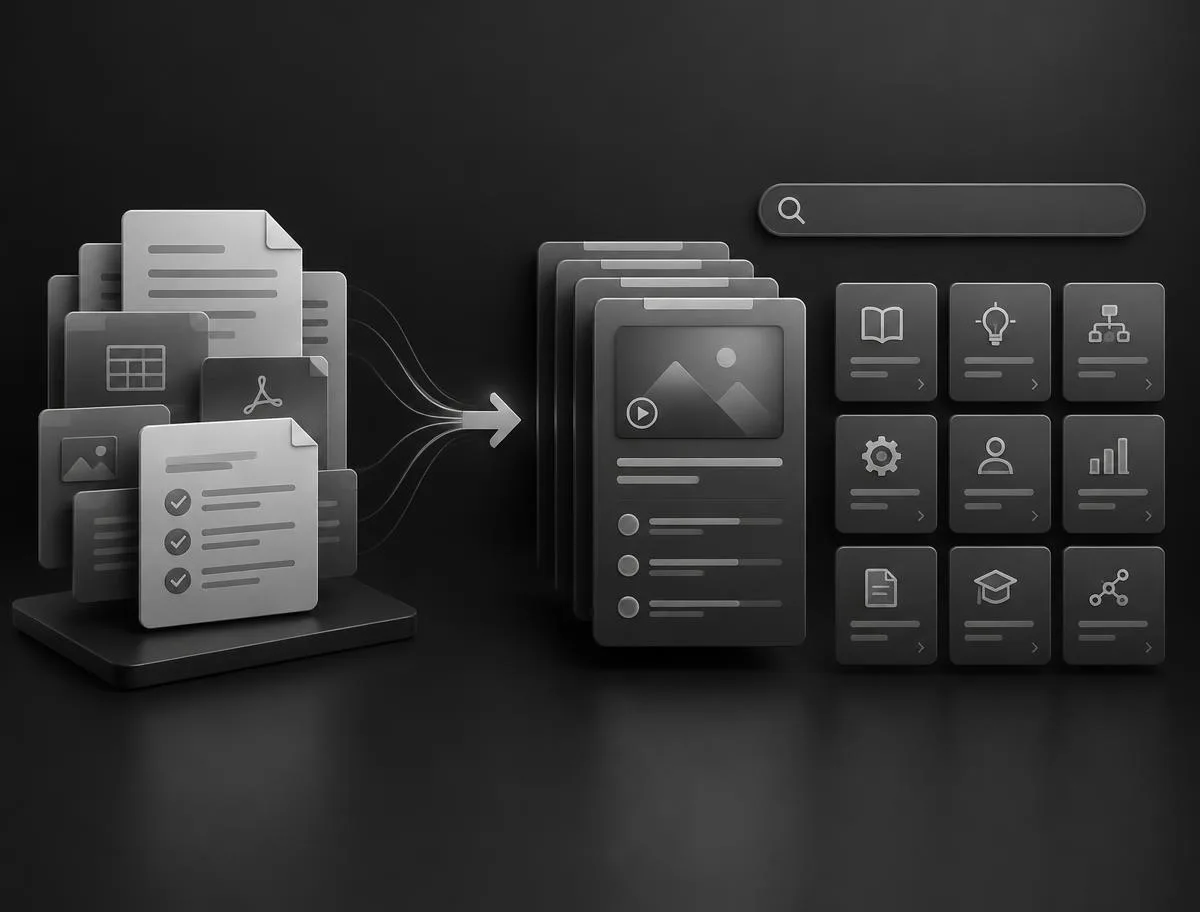
Learning Vault is Breakfree's AI-native centralised knowledge repository. It brings an organisation's knowledge into one place and makes it easy to find, so people can learn on the job.
It connects organisational knowledge with learning, helping HR, L&D and business leaders turn existing information into capability.
How is an AI knowledge repository different from a document library?
A document library gives you a place to store files. A useful knowledge repository must also make that information usable in day-to-day work and connect it to training and onboarding.
When evaluating a repository, ask how people find information, how they identify the current approved document, who owns updates and how expert know-how is captured. These are requirements to validate, not features to assume.
Why is this an adoption and change issue, not an IT issue?
A knowledge tool only works if people use it and add to it. That's a behaviour change, and it needs HR, L&D and business unit heads working together.
In our experience, four things decide whether a knowledge repository sticks:
- Leaders model it. When a manager answers a question with "it's in the Vault", people follow.
- Process owners keep it current. When a product or process changes, the owner updates the Vault before the change goes live.
- Experts get credit. Sharing knowledge should count in recognition and reviews.
- It fits into daily work. If finding an answer takes longer than asking a colleague, people won't use it.
What results should HR and L&D measure?
Measure whether new joiners find answers faster, whether teams receive fewer repeat questions and whether training uses current process documents. Establish a baseline before introducing a repository, then compare the results rather than assuming an improvement.
How do you start without boiling the ocean?
Start with a focused, practical approach.
- Pick one team where knowledge risk is high. Good candidates are a shop floor or operations team, a process team, a client-facing team or a team with experts close to retirement.
- Gather the top 20 documents people actually use. Skip the archive.
- Record 3–5 short expert walk-throughs of the things only they know.
- Run a 30-day pilot with new joiners. Track how quickly they find answers.
- Name a content owner before you scale up.
What is an AI knowledge repository?
It's one central place for an organisation's documents and know-how, where AI helps people find answers quickly. Learning Vault is Breakfree's version.
What is SOP version control?
It tracks which version of a procedure is current, who approved it and what changed. That way, nobody works from an old copy.
How do you keep SOPs up to date?
Give every SOP one approved version, a named owner and a review date. Then update it before a process change goes live, not after.
Why do process documents go out of date?
Products and shop floor practices change faster than the documents. Often, nobody owns the update.
Checklist: is your knowledge at risk?
If you ticked fewer than five, your knowledge is more fragile than it looks.
- We know which roles hold knowledge nobody else has
- New joiners can find answers without always asking someone
- Every SOP has one approved version, a named owner and a last-reviewed date
- When a product or process changes, the documents change too
- Our process flows match what actually happens on the floor
- Expert know-how is captured, not just remembered
- Our training is built on current documents
- Our onboarding uses this knowledge, not just a slide deck
See what Learning Vault could mean for your team
Want to see how Learning Vault would work for one of your teams? Request a demo on our contact page.
Source
Panopto Workplace Knowledge and Productivity Report, via HR Dive (2018). These are historical research estimates, not Learning Vault results.
Want this working in your organisation?
Talk to us about how this product could support your team.
Start a conversation